B2BComplianceComplex workflowsAutomated decisions

They had the whole product in their heads, in three separate pieces.

Jardin was targens' first product for mid-sized companies, and I was its only designer. I joined two of them into one record, from adding a business partner to the person who signs off its risk.

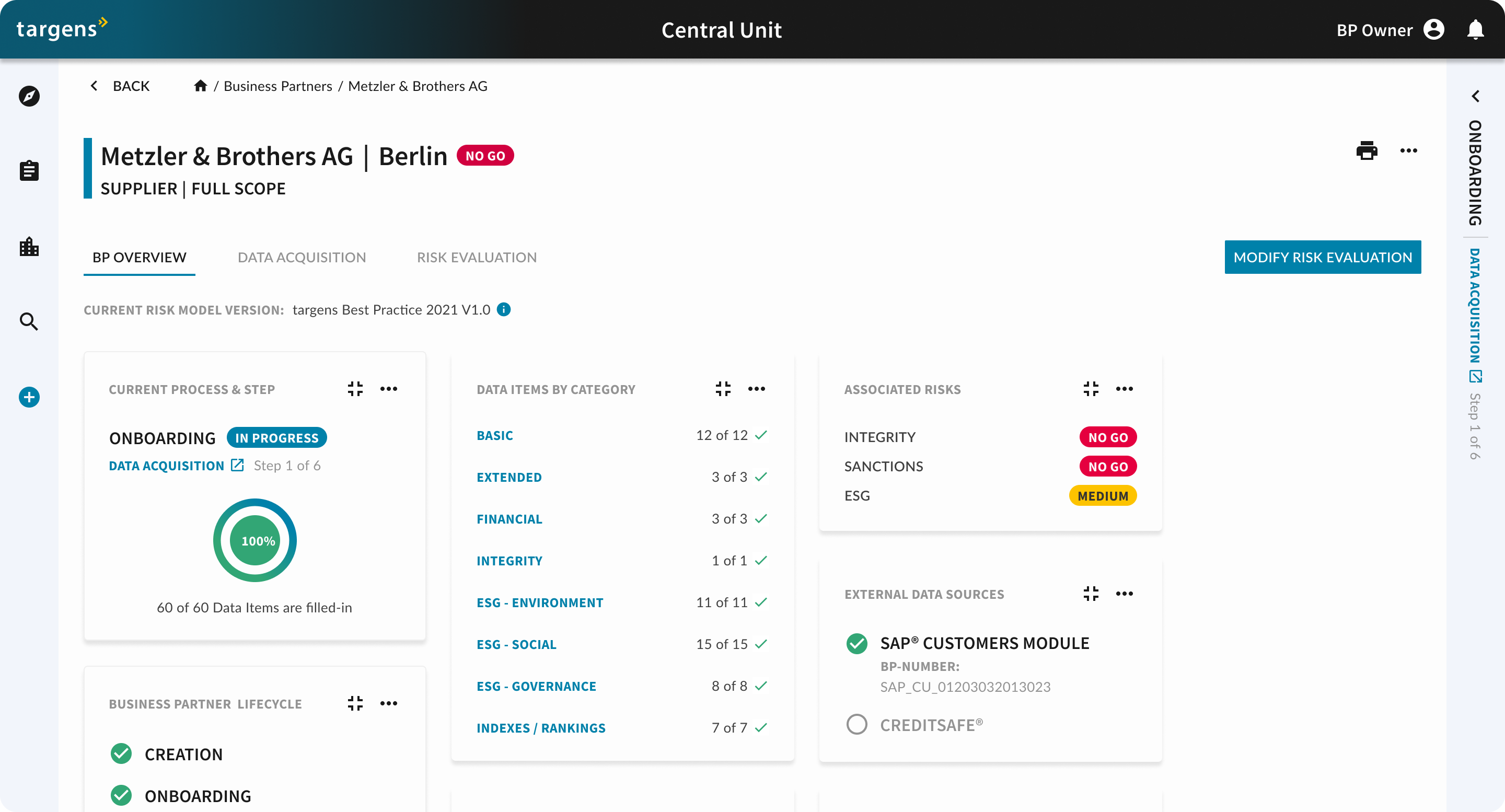
The business partner dashboard once the evaluation is done: the case marked No go, each risk area with its own result, the data items by category, and the version of the risk model used.
Where the pieces meet: one record, one status for the whole case, one result for each risk area, and the version of the risk model behind it.
Role: UX/UI Designer Company: targens GmbH, through UX Studio Timeline: 6 months in 2021, launched July 2022
In a nutshell

targens had built compliance software for banks for thirty years. Jardin was its first product for mid-sized companies that have to prove who they do business with, and it existed as a vision deck, with every role worked out in detail and each one in its own flow.

I was the only designer, with a researcher and the client's product manager. In six months, from two days of kick-off, the deck became one process, tested with people who do this work and solid enough to show to buyers before it was finished being coded. I ran the information architecture workshop, designed every flow and screen, and built the design system, including the brand and colour work.

6 monthsfrom a slide deck to designs shown to buyers.
2 flows, 1 recordtwo roles merged into one process before any screen was drawn.
Extendedafter the first contract, the client kept extending the collaboration, milestone after milestone.
    Where it started

    Every role worked out, each in its own flow

    They knew the domain. I knew the questions I needed to ask.

    Their product manager had worked in compliance for years: the departments, the stages, the data sources and the approval rules were all clear. Every role was worked out in so much detail that each one lived in its own flow, and the process running across the three was still to be drawn. The questions I asked as a newcomer were the ones the people using it would ask too.

    The decision I would defend

    Three people and the system, around one record

    I set out to understand the work of a risk analyst and a data collector in depth: what they look at, how, and where. The flow came out of that.

    The collector and the evaluator turned out to be looking at the same company at two different moments of its life: same business partner, same documents, picked up later by somebody else. I noticed it when I put the two role descriptions side by side on one page. Described one at a time, they looked like two different jobs. Drawn as one record moving through stages, most of the duplication was never built.

    One record. Four roles around it.Pick a role
    Sets it up
    Administrator
    Process
    What counts as a risk here, who evaluates it, in what order.
    Adds and collects
    Collector
    Onboarding
    The business partner, the documents, what is known.
    Not startedIn evaluation
    Scores
    The system
    Risk evaluation
    Sanctions lists, databases, news. Data, not decisions.
    Decides and signs
    Evaluator
    Decision
    Checks what the system found. The name on the decision.
    GoNo go
    Sets up the processWorks inside the company that bought the software. Decides what counts as a risk, who may evaluate it and in what order. The only one of the four who is not looking at another company.
    Starts the recordAdds the business partner, chases the documents, fills in what is known. Usually the person closest to the relationship, and the one with the least time.
    Scores what was collectedGoes through sanctions lists, external databases and news, following the process the administrator built. It produces data, not decisions.
    Signs it offChecks the risks the system found, against the documents the collector gathered, and decides. The name on the decision.
    The flow, in three stepsPlays on its own
    The same supplier gets added three times under three names. So adding one starts by looking for it.
    The hard part

    Everything was important

    For the client, every field was essential. The job was not to hide information. It was to decide what the person needed to know first.

    I facilitated the information architecture workshop with their product people in the room, laying out what lives where together instead of me proposing a structure for them to react to. A structure the client helped build is a structure the client defends later, and on an agency project that matters: I was not going to be in the room when somebody proposed changing it.

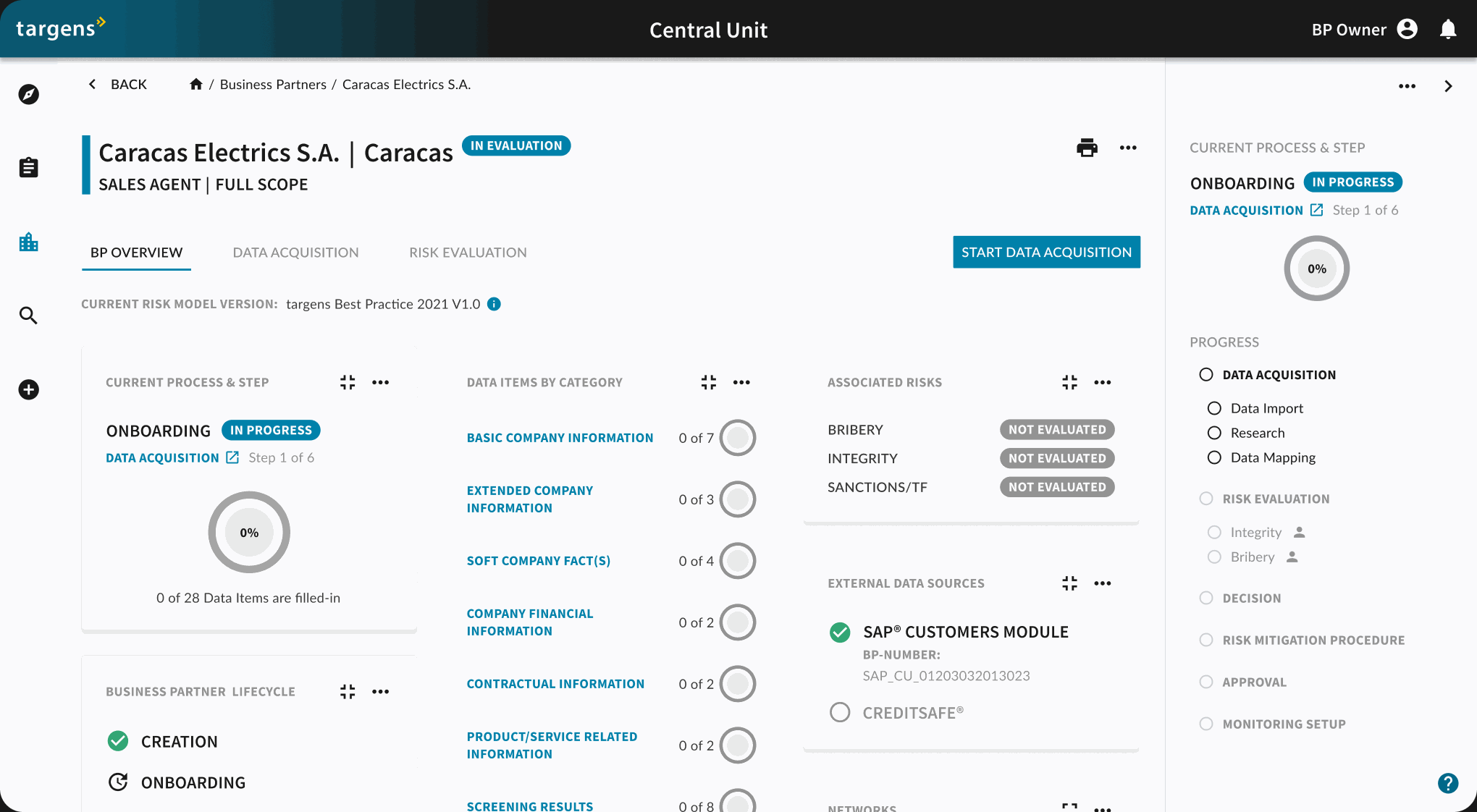
    The business partner overview: the case status, a progress ring with 0 of 28 data items filled in, the data items by category, and three associated risks marked not evaluated.
    1. State

      One status for the whole case, the same on every screen.

    2. Progress

      How much data is still missing, so everybody can see how far the case is from being evaluated.

    3. Not evaluated

      No result is not the same as a clean result, so it gets its own state.

    The risk screen

    A score the analyst can argue with

    When a system does part of the work, the screen has to make clear what came from the system and what the person still decides.

    The scoring was in the client's vision. What it should look like was not: the analyst has to see how the system reached a score, and be able to disagree with it. Any score can be changed, as long as the evidence for the change is attached. I tried several formats before landing on the order the decision is actually made in. It is dense on purpose, because the alternative is a summary somebody has to take on trust. The requirement was theirs. The format was mine.

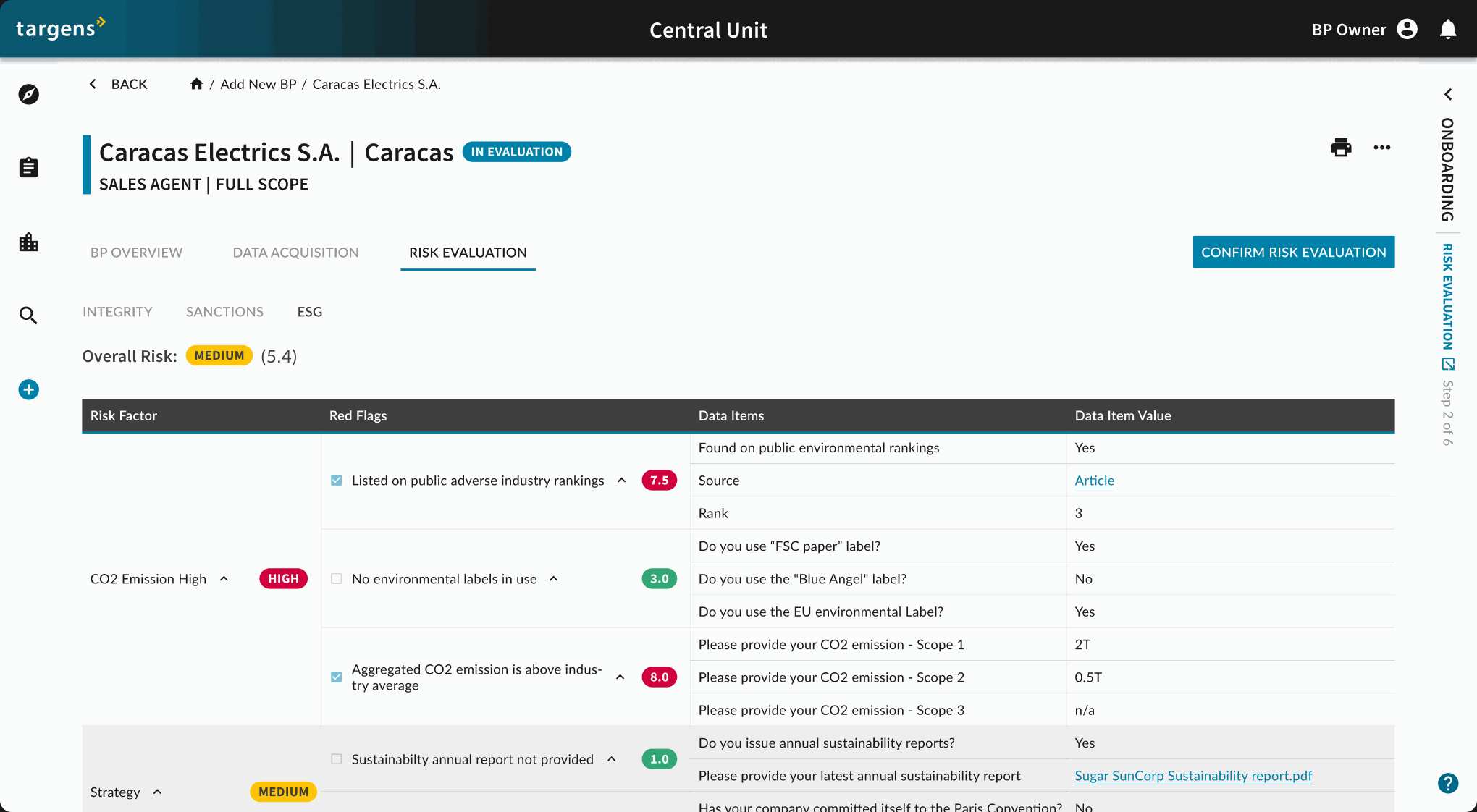
    The risk evaluation screen: the overall risk with its score, the red flags under each risk factor with their weights, the data items and sources behind each flag, and a button to confirm the evaluation.
    1. Score

      The number is always there, never a label on its own.

    2. Why

      Every red flag underneath carries its own weight.

    3. Evidence

      The data item, its value and its source, one click away.

    4. A person decides

      The analyst confirms each flag, or changes the score with the evidence attached.

    What I handed over

    A system someone else can build from

    In a product where somebody signs off on a risk, colour is the fastest thing on the screen, and it has to say the same thing every time.

    I wrote the system so somebody who had never met me could build the next screen: status colours defined once, every state of every component, and the decisions from the flows turned into components. I was going to leave, and the file was going to stay.

    Four pieces of the system, and why each one exists. Drag, or use the arrows.
    1 / 4
    State

    Colour means something

    Caracas Electrics S.A. | Caracas In evaluation
    SALES AGENT | FULL SCOPE

    Wherever the business partner appears, its state reads the same. Five status colours, each defined once with its hex, and the header carries them all.

    Component

    Every state exists

    Bribery Low
    Integrity Not evaluated
    Sanctions / TF Medium

    Including the one nobody has looked at yet. A risk nobody has examined is a different fact from one that came back clean, and the person who signs it off needs to see the difference.

    Rule

    Decisions become reusable patterns

    Business partner name
    Caracas Electrics Supplier
    There is already a “Caracas Electrics S.A.” with the BP Type “Supplier” in your database. If you continue, you are going to be redirected to that Business Partner Relationship.

    It came out of drawing the flows, and it went into the system with its wording already written. That is how a decision survives the person who made it.

    If I built it today

    Names an engineer can import

    status.in-evaluation#0081AA
    status.go#32A675
    status.no-go#D1003F
    risk.medium#FCC307
    risk.not-evaluated#939393

    This was 2021, and there are no tokens in the file: Figma shipped variables after the project ended. Today I would add that layer, so the status colours become names instead of hex codes, and make the risk chips readable without colour, which I learned a year later at BlackRock.

    What testing showed

    They could use it. They wanted to be guided.

    A researcher at the agency recruited and analysed. I was in the prep sessions where we wrote the questions, and in every session, asking follow-ups when something needed pushing. The client recruited their own contacts, which in a field this narrow makes sense, and they were very sure of their hypotheses. So what we learned went onto the architecture itself, next to the node it was about, where it would still be when somebody asked the same question after I left.

    The one I still think about came from the last round. Everybody completed every task without help, and then said they would rather the system led them.

    It is not immediately clear to me which steps come first and which come next.

    The screens worked; the order of the steps was not obvious yet. A task-completion score would have called that round a success. Usable and guided are not the same thing, and that was the next thing to design.

    What survived

    Product
    Launched in July 2022, and sold to customers a year after the kick-off.
    Client
    Extended the engagement at every milestone, and sent the agency team a Christmas present.
    Handoff
    Another designer picked it up, with two weeks of overlap and a file built to be inherited.
    Metrics
    None survived. targens was acquired the following year and the product was discontinued.

    Jardin was my first product in compliance. Since then, from the charts at BlackRock to Bicho Feliz NGO, I keep designing for people who have to trust what a system tells them.

    Lucila Di Vanni Frick

    Hola, I'm Lu. Senior Product Designer, 6+ years across different industries. I start with the real problem, make complexity understandable, and stay close to the outcome. More about me →